The Interactive Mode of Pyevolve is the only part of Pyevolve which is platform dependant, I’ve created the platform dependant code for Win and Linux, but not yet for Mac, I’m working on that issue for the next release 0.6 of Pyevolve, but there is a way to enter in the Interactive Mode on the Mac, it’s a workaround for a while, this is the code:
From Modis Rapid Response System site:
The MODIS Rapid Response System was developed to provide daily satellite images of the Earth’s landmasses in near real time. True-color, photo-like imagery and false-color imagery are available within a few hours of being collected, making the system a valuable resource (…).
The Moderate Resolution Imaging Spectroradiometer (MODIS) flies onboard NASA’s Aqua and Terra satellites as part of the NASA-centered international Earth Observing System. Both satellites orbit the Earth from pole to pole, seeing most of the globe every day. Onboard Terra, MODIS sees the Earth during the morning, while Aqua MODIS orbits the Earth in the afternoon.
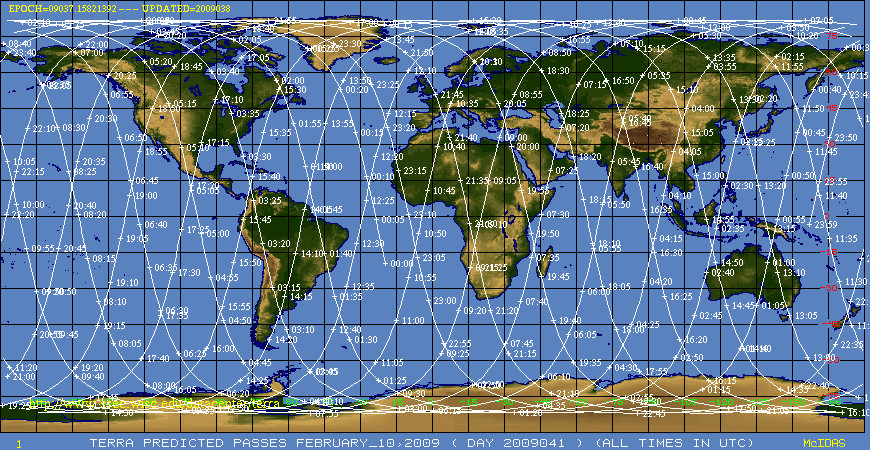
One thing that a few people know is that everyone can have access to a near real-time moderate resolution images from two NASA satellites (Aqua and Terra) which orbits the earth from pole to pole every day and captures images and data like thermal anomalies from the most part of the globe.
In this post, I’ll show how to get and plot those imagery and data to a map using Python and Matplotlib + Basemap toolkit.
The Aqua and Terra orbits
(more…)
I’m currently working on the distributed GA support for the Pyevolve framework, the approach I’m using to network communication (individuals migration) is the hightweigh and unreliable UDP protocol, due it’s performance (for lan/wan) and broadcasting compatibility.
The distributed GA will have options to create the logical migration topology for the connected nodes (islands of evolution), migration schemes, migration rates and other parameters.
